Ancient Greece: An Illustrated History - Book Review
January 21, 2022
There are better formatted books in the market today, but if you don't mind a 70's style of book and writing style then you'll enjoy the content and the way it's laid out.
From the Back Cover
The influence of the Greeks on western society has been greater and more fundamental than that of any other nation. It has touched almost every sphere, from ethics, philosophy, and politics to literature, science, esthetics and even language.
Peter Green has written an authoritative and witty study - complemented by a wide variety of illustrations - of Greece during the centuries which preceded the Hellenistic age.
After considering the mass of evidence which exists today to build up our picture of prehistoric Greece, Profession Green then describes the culture of the Minoan Crete, with it’s astonishing modernity; the Mycenaean civilization in Homeric tradition and in historic fact; and, the flowering in culture and political thought which behan in the mid-eighth century BC.
He discusses the forces at work in the rise and fall of the polis or city-state, and puts in perspective the roles of the tyrants and lawgivers, the philosophers and military commanders, the poets and sculptors.
The growth of Athenian democracy, Hellenism, and the Persian Wars are all examined, together with the reversion to authoritarianism in the age which ended with the death of Alexander in 323 BC - the concluding point of the book.
Throughout, the author draws together the strands of the story into two major themes: exploration and discovery - both in a literal and creative, intellectual sense - and the Greek impulse to set the world in order, to rationalise it and to formulate abstract laws. The result differs widely from the traditional military-political narrative, giving an entertaining and informative picture of the many facets of Greek culture and history in the period.
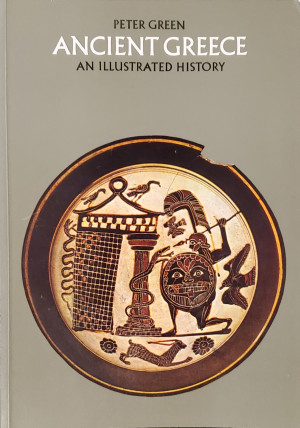
Details
- 1973 (1991 Reprint)
- Thames and Hudson
- Written by Peter Green
What’s the Book About?
From prehistory to the death of Alexander the Great, this book delves into the history of the Greek civilization, looking at it from the perspective of the people and their unique take on the world.
The book is broken up into 5 chapters:
- From Stone to Iron: The Prehistoric Period
- The Crystallisation of the City-State (750-600 BC)
- Reason, Tradition and the Persian Wars (600-479 BC)
- Democracy and Empire: The Paradigm of Athens (478-404 BC)
- The Reversion to Authoritarianism (404-323 BC)
Did I Like It?
The book was okay. Green does a good job moving from one period to the next in Greek history. While I have the 1991 edition, this is an exact reprint of the 1973 edition (it has a reference to a 1972 resurgence of a Greek poet named Sappho on American university campuses (p. 79).
The text in the book is crammed in. There’s a lot of text in this 192 page book and it definitely doesn’t feel like a book you’d pick up at your local chain bookstore (I picked it up at a thrift store). The format of the book is dated, which isn’t necessarily a bad thing.
The images were all black and white and provided support to the narrative. The maps outlining the cities and territories in Greece, Crete and Asia Minor were pretty small so I took pictures of them and enlarged them on my phone.
The Content
From Stone to Iron: The Prehistoric Period
The book starts off with how archaeologists are able to identify different periods based on different kinds of pottery (or ash) at different levels of strata. It then goes into the climate of Greece, identifying areas that were once filled with natural timber or lush with pastures and how, over time, these areas dwindled into localised areas where groups gathered and developed a community.
The book examines Minoan and Mycenaean civilizations prior to 1300 BC and talks about their contrasting views: The Mionans a free and open society where the land was fertile and plentiful; the Mycenaeans who migrated from the north into Greece and brought farming and walled fortifications.
The chapter ends with the battle of Troy, the fall of Mycenaean civilization to raiders from the north of Greece and Homer’s epic and how this led Greeks to see the Mycenaean period as the age of heroes.
The Crystallisation of the City-State (750-600 BC)
Green then goes into how city states began to form through the codification of laws, and colonisation of different parts of the Mediterranean began to occur - especially to the east (Asia Minor) and the west (Sicily).
Trade with near eastern civilizations brought new ideas, influences and myths to the Greek mainland as well as new prosperity for non-land owners. Traders grew rich and the idea of class distinction based on birth, land-ownership or wealth began to erode.
This was especially true with the introduction of the phalanx (700 BC) where a citizen of any class would stand side by side defending a comrade with his shield and fighting for the polis. We start to see a shift from the heroic values of the characters in Homer’s epic to a human-centric view where men made the polis.
Reason, Tradition and the Persian Wars (600-479 BC)
Trade, as always, plays an important role in classical civilization. Athens was in trouble - it was importing more than it was exporting and the different classes were ready to rebel against each other.
The Solon reforms (594 BC) in Athens did a lot of things to alleviate this. Additionally, he banned the export of produce except for olive oil and tried to make Athens an export society, instructing fathers to teach their son’s a trade, and offering citizenship to skilled craftsmen who would choose to settle in Athens. He also implemented a reclassification of citizenship where wealth and not birth was the driving force.
Solon knew that a prosperous and well fed nation was a happy nation.
Cleisthenes was next and divided Attica (the greater Athens) into 170 burroughs which were a cross section of the population. Each borough had its own local assembly, treasurer and mayor. This helped further strengthen the polis as it meant people had more duty to their borough then the clan (which was now spread thinly across several boroughs, leading to a deterioration of kinship for clans).
As the Persian threat grew Athens saw it’s trade (ie food and timber) security in danger and tried to help Ionia in Asia Minor. Athens torched Sardis which was a bad move as it gave Darius a reason to invade. At Marathon (490 BC) the Persians suffered a major defeat which boosted Athenian morale in the concept of the polis. Green goes on to talk of the battle at Salamis and the herculean efforts (and extreme luck) Themistocles had in defeating the Persians (rebellions in Egypt, kicking out his opponents for 10 years, hitting a silver mine - incredibly lucky).
Democracy and Empire: The Paradigm of Athens (478-404 BC)
To keep the Persian threat in check Athens created the Delian league which didn’t sit well with the Peloponnesian league (led by Sparta). The concept of science, man’s place in nature and a homo-centric approach were challenges that the older traditions found offensive and laws were enacted to deter these “free thinkers”.
With the signing of the Peace of Callias in 449 BC, Persia was no longer a threat but Athens continued to act like an empire, eventually leading to war against Sparta.
The Reversion to Authoritarianism (404 - 323 BC)
The final chapter talks about Macedonia and Phillip II’s consolidation of power in Greece (Athens got off lucky, Boeotia - in particular Thebes didn’t) and the rise of Alexander the Great, his Greek influences and his empire. Everybody loves a winner, and with the booty coming back from Alexander’s military exploits no one in Greece was complaining.
Who is this Book For?
While I wouldn’t recommend this book to today’s reader of history, this book is a great introduction to Ancient Greek society.
There are better formatted books in the market today, but if you don’t mind a 70’s style of book and writing style then you’ll enjoy the content and the way the content is laid out.